
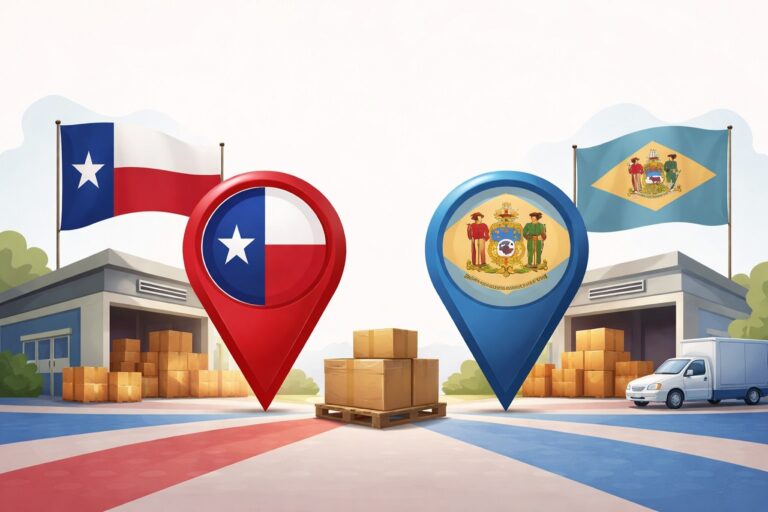
For most eCommerce founders, Delaware is the better choice if your priority is low-friction setup, investor familiarity, and tax efficiency around entity formation, while Texas is the better choice if you are actually building real operations there, hiring there, storing inventory there, or selling heavily into Texas from day one.
In plain terms, Delaware usually wins as a legal home for an online-first brand, but Texas wins when it is your real operating base. The mistake many sellers make is treating “best state” like a universal answer. It is not. The better choice depends on whether you are choosing a formation state or an operating state.
That distinction matters because an eCommerce business can be formed in one state and still owe registrations, filings, and tax compliance in another if that is where it actually does business.
Delaware has no state or local sales tax, which makes it attractive on paper, but Delaware also imposes business license obligations and gross receipts taxes on businesses operating in the state.
Texas, on the other hand, imposes sales tax and franchise tax rules, but it also gives many smaller entities breathing room through its current no-tax-due threshold of $2.65 million for 2026 franchise-tax reporting.
The Real Question Most eCommerce Owners Should Ask

The better question is not “Which state sounds cheaper?” but “Where will my company actually create nexus, store goods, hire people, receive shipments, and handle daily operations?” That is what determines whether a state choice gives you simplicity or just adds paperwork.
If you form in Delaware but physically run the business from Texas, you may still need to register in Texas as a foreign entity and comply there.
Texas says foreign entities other than nonprofits generally pay a $750 registration fee to register when doing business in the state. So a seller who forms in Delaware and then truly operates in Texas can end up paying for Delaware formation and Texas registration and compliance.
That is why many small and mid-sized online sellers do best with a simple rule: form where you operate unless you have a specific reason not to.
Delaware becomes more attractive when you expect investors, legal complexity, multiple owners wanting a familiar structure, or a logistics model that actually benefits from Delaware’s tax position. Texas becomes more attractive when the business is really Texas-based and you want one main compliance home instead of two.
| Factor | Texas | Delaware | Better For |
| LLC formation filing fee | $300 | $90 | Delaware on upfront cost |
| Annual LLC state-level obligation | Franchise-tax filing framework; tax may be zero below threshold, but information reporting still applies | $300 annual LLC tax; no annual report for LLCs | Texas for many smaller LLCs below threshold; Delaware for simplicity of fixed rule |
| State sales tax | 6.25% state rate, up to 8.25% combined with local | No state or local sales tax | Delaware |
| Remote seller rule | $500,000 safe harbor before tax permit/collection duty | No sales tax system, but Delaware gross receipts tax applies to businesses operating there | Depends on business model |
| Court system reputation | New Texas Business Court launched September 1, 2024 | Court of Chancery remains the best-known business-law forum in the U.S. | Delaware for legal predictability |
| Business license exposure if operating there | Varies by local and state obligations | General business license generally starts around $75 for first location, plus category-specific rules; retail licenses include a retail crime fee | Texas often simpler if not operating in Delaware; Delaware still useful for certain logistics setups |
Why Delaware Keeps Showing Up In eCommerce Conversations

Delaware is popular for reasons that go far beyond the cliché of “business-friendly.” The real draw is a package: low LLC formation cost, predictable annual LLC tax, a mature corporate law system, and a court structure that has decades of experience dealing with internal business disputes.
The Delaware Court of Chancery itself says it is the nation’s preeminent forum for disputes involving the internal affairs of Delaware entities. That matters much more to funded startups, multi-owner brands, and businesses that want clean legal precedent than it does to a solo Shopify seller shipping ten orders a day.
For LLC owners, Delaware’s rule is easy to understand: domestic and foreign LLCs formed or registered there generally owe $300 per year, and Delaware says LLCs do not have an annual report requirement in the same way corporations do. That simplicity appeals to founders who prefer a fixed annual cost instead of tracking multiple moving parts.
Delaware also attracts eCommerce operators for a different reason: it has no state or local sales tax. That does not mean “no tax at all,” and that misunderstanding causes a lot of bad advice online.
Delaware’s own revenue guidance says there are no state or local sales taxes, but businesses operating in Delaware can face business license requirements and gross receipts taxes on sales made in the state. So Delaware is not tax-free in a broad sense. It is simply built differently.
Formation State Versus Operating State
This is the section most founders need to read twice.
Your formation state is where the entity is legally created. Your operating state is where the company is actually doing business. If those are different, you can end up with two layers of compliance. That is not always bad. It just has to be worth it.
A Delaware formation can make sense for an online brand that wants a clean legal structure, future investor credibility, or a Delaware-centered logistics model. But if your company is truly based in Texas, then forming in Delaware may add an extra state registration, another registered-agent relationship, another annual obligation, and more administrative work.
Texas itself makes clear that foreign entities doing business there generally need to register, and the fee for most for-profit foreign entities is $750.
That is why the cheapest-looking state on a blog list is not always the cheapest real-world option. A founder may see Delaware’s $90 LLC filing fee and assume it is obviously the winner, but if they immediately need Texas foreign qualification, the low Delaware entry cost becomes much less impressive.
Tax Reality For eCommerce Sellers
Tax is where this comparison stops being abstract.
Delaware Tax Reality
Delaware does not charge state or local sales tax. That can be useful in certain supply-chain situations, particularly when inventory, prep, or fulfillment flows through Delaware. But Delaware does impose gross receipts tax on sellers operating in the state, and those rates vary by business activity.
Delaware’s own guidance says gross receipts taxes generally range from 0.0945% to 1.9914%, with some higher variable categories, and filing may be monthly or quarterly depending on volume.
It also generally requires a business license for businesses operating there, and the annual license fee is generally $75 for a first location, with retail licenses subject to an added retail crime fee in relevant categories.
So Delaware is powerful for the right eCommerce setup, but not because it magically removes tax. The real advantage is that it removes sales tax at the state level and can support lower-cost inbound inventory strategies when your business model fits.
Texas Tax Reality
Texas has a broader consumer-facing sales-tax structure, but its franchise-tax regime is friendlier to many smaller businesses than people assume. If annualized total revenue stays at or below $2.65 million for the 2026 report year, many entities will not owe franchise tax, though filing obligations may still remain.
Texas also offers a remote-seller safe harbor of $500,000 in Texas revenue over the preceding twelve months before permit and collection obligations kick in. Marketplace rules can also shift responsibilities when sales happen through marketplace providers.
For a founder actually living and operating in Texas, that combination can be easier to manage than a Delaware structure plus Texas foreign registration. In other words, Texas is often better not because its tax system is lighter in theory, but because it may produce less duplicated compliance in practice.
Where Delaware Can Create A Real eCommerce Edge

Delaware becomes especially attractive when your business is built around inventory movement, prep, or fulfillment rather than just entity prestige.
That is where the logistics angle matters. A Delaware-based prep and fulfillment setup can turn the state’s no-sales-tax environment into an operational advantage, especially for Amazon, Walmart, FBM, and multichannel sellers moving physical goods through the state.
On its own site, Dollan Prep Center describes itself as a Delaware prep center serving Amazon FBA, Walmart, and FBM sellers, and says its tax-free location helps sellers save money on inbound shipments. It also highlights FTL programs, fast check-ins, and support for FBM fulfillment, storage, returns, and kitting. That is the kind of context where Delaware is not just a legal filing state but a useful logistics state.
Legal Predictability And Investor Optics
Delaware still has a major edge in legal reputation. The Court of Chancery remains one of the strongest reasons sophisticated companies choose Delaware, especially when ownership structures become more complex.
If you plan to raise money, issue equity, bring in multiple owners, or eventually sell the company, Delaware gives lawyers, investors, and acquirers a familiar playbook. That is not hype. It is one of the main reasons Delaware has stayed dominant for so long.
Texas is moving in that direction. The Texas Business Court officially began operating on September 1, 2024, and it was designed to handle certain complex business disputes. That is important and worth watching.
But it is still new compared with Delaware’s very mature corporate-law ecosystem. For a founder deciding today, Texas may be improving fast, but Delaware remains the more established choice for legal predictability around entity disputes and governance.
Which State Is Better By Business Type?

Solo Shopify Or Amazon Seller
If you are a solo founder and your real home base is Texas, Texas is usually the better choice. You avoid layering Delaware on top of Texas. Your formation fee is higher, but you may save time and money by not foreign-registering later. And if your revenue is below the current Texas no-tax-due threshold, the franchise-tax burden may be lighter than many people fear.
Brand Expecting Investors Or Multiple Owners
Delaware is usually stronger. Investors and attorneys know the system. Governance questions are more standardized. The legal infrastructure is deeper. That matters more as the company becomes more sophisticated.
Physical-Goods Seller Using Prep, FTL, Or East Coast Inventory Routing
Delaware can be very compelling, especially when your inventory flow actually benefits from being processed in a tax-free state. This is where the state can generate real operational savings instead of just theoretical legal benefits.
Seller Building A Genuine Texas Base
Texas is usually the better operational answer. If your people, warehouse, and management are in Texas, forming there often means fewer moving parts.
Final Verdict
Delaware is the better choice for an eCommerce store when you want a clean legal home, strong investor optics, predictable entity law, or a logistics model that genuinely benefits from Delaware’s no-sales-tax environment.
Texas is the better choice when Texas is your actual operating state and you want to keep compliance simpler.